DIY Guide: Concrete Base for Shed Installation

This practical guide shows UK homeowners how to build a sturdy concrete base for shed DIY projects. It sets out the full scope: site planning, tools and materials, excavation, formwork and reinforcement, mixing and pouring, curing, troubleshooting and cost considerations. The aim is a clear, professional shed base guide that helps you achieve a compliant garden shed foundation with sensible safety steps.
Designed for competent DIYers and homeowners across the United Kingdom, the article assumes basic DIY experience but explains specialised tasks such as mixing concrete, levelling and reinforcement in plain terms. Where relevant, procedures reflect UK weather and regulatory considerations so your DIY shed foundation UK meets practical and safety expectations.
Inhaltsverzeichnis
Key Takeaways
- Follow a step‑by‑step approach to ensure a level, durable garden shed foundation.
- Plan location, size and drainage before digging to avoid costly rework.
- Use the right tools, concrete mix and reinforcement to reduce cracking and settlement.
- Allow correct curing time and protect the base from frost and heavy rain.
- Compare DIY costs with professional quotes and know when to hire a specialist.
Why a Solid Base Matters for Your Shed
Choosing the right base under your shed affects performance, maintenance and any future claims. A level, permanent foundation stops many common problems before they start. The points below explain the practical advantages for everyday use in UK gardens.
Structural benefits of a concrete base
A rigid concrete slab gives uniform load distribution across the floor. That prevents local sagging and keeps doors and windows square, which improves shed stability and reduces wear on hinges and frames.
Concrete resists ground movement better than timber skids or loose paving. It lowers the risk of settlement linked to frost or burrowing pests. A permanent slab can help prevent rot by keeping timber elements off damp ground.
Longevity and maintenance considerations
When installed correctly, a concrete base can last for decades with minimal upkeep. Occasional resealing or targeted surface repairs keep the slab attractive and reduce water ingress.
Proper drainage and a suitable surface finish, such as brushed or trowelled concrete, limit frost damage and standing water. Compared with timber or gravel options, maintenance demands are lower and long‑term costs are often less.
Impact on shed warranty and insurance
Many manufacturers, including Tiger Sheds and Jacksons Fencing, expect a level, permanent base. Failure caused by an inadequate foundation can void a shed warranty UK customers rely on for parts and structural cover.
Insurers may require stable foundations for outbuildings used to store valuable equipment. Keep records, invoices and photographs of the installation to support any warranty or insurance claim related to shed stability or damage.
Planning Your Concrete Base: Size, Location and Regulations
Good planning makes the build simpler and prevents costly mistakes. Before digging, review the garden and note levels, drainage and access. Consider how the shed will be used and how the base will perform over time.

Pick a level, well‑drained spot with clear access for materials and future maintenance. Keep distance from tree roots and avoid placing the base over buried services. Think about sun exposure and prevailing winds for ventilation and comfort.
Choosing the right location in your garden
Assess proximity to boundaries and neighbour views. A base near fences may need extra clearance for painting and repairs. Check for slopes; a stepped or levelled area reduces excavation time.
For shared drives or narrow gardens, plan access for ready‑mixed concrete or mixers. If noise or privacy matter, position the shed to reduce neighbour impact while keeping the entrance practical.
Measuring and calculating base size
Always allow a margin around the shed footprint. A rule of thumb is to add 50–100mm on each side for fixings and finishing. For example, a 2.5m x 2.0m shed needs a 2.6m x 2.1m pad.
Base dimensions affect strength. Aim for 100–150mm thickness over a compacted sub‑base for most garden sheds. Increase thickness or add reinforced edges if you expect heavy equipment or a concrete floor that supports loads.
Local planning rules and permitted development in the UK
Small garden buildings often fall under permitted development, but rules on height, distance from the house and use vary. Sheds converted to habitable rooms can trigger building regulations.
Check Planning Portal guidance and your local council for restrictions in conservation areas, listed properties or flood zones. When unsure, contact the local authority to confirm whether your project qualifies as a permitted development shed.
| Aspect | Practical guidance | Typical recommendation |
|---|---|---|
| Site selection | Choose level, well‑drained ground clear of roots and services | Avoid slopes; allow access for materials |
| Pad size | Add 50–100mm to shed footprint for fixings and finishes | 2.5m x 2.0m shed → 2.6m x 2.1m pad |
| Thickness | Depends on sub‑base and load; thicker edges for heavy use | 100–150mm standard; increase for heavier loads |
| Regulations | Confirm permitted development limits, height and use | Refer to Planning Portal and local council rules |
| Practical checks | Survey for underground utilities, drainage and sunlight | Use utility maps or contact local providers |
Required Tools and Materials for a Concrete Base for Shed DIY
Preparing a reliable base starts with the right kit and materials. This short guide lists what you need, suggests suitable concrete strengths and reinforcement, and points to where to buy supplies in the UK while keeping an eye on building materials cost.

Essential tools
- Tape measure for accurate dimensions and squaring the base.
- Spirit level and optional laser level to set true horizontal planes.
- Builder’s line and timber pegs to mark out and maintain straight edges.
- Spades and a mattock for digging and root removal.
- Plate compactor or hand tamper to consolidate the Type 1 sub‑base.
- Wheelbarrow for moving aggregates and mixed concrete.
- Concrete mixer for DIY volumes, or plan to order ready‑mix concrete.
- Timber for formwork (CLS battens or treated decking offcuts), hammer, nail gun or screws and a drill.
- Steel float, wooden float and edging trowel for finishing the surface.
- Rake for levelling the wet concrete and protective gear: gloves, goggles, dust mask and Wellington boots.
Materials and recommended mixes
Start with a compacted Type 1 crushed aggregate sub‑base. Add a blinding layer of sharp sand where needed to level the sub‑base.
For the concrete mix for shed base, use C20/25 strength. A typical on‑site mix approximates to 1:2:4 (cement:sand:coarse aggregate) by volume. Aim for a finished thickness of 100–150mm, using 150mm for heavier loads or larger sheds.
Consider fibre‑reinforced mixes or SBR additives to reduce cracking. For reinforcement, A142 or A193 mesh sheets work for most domestic bases. You can use a single layer of BRC mesh or place rebar if specifications require greater strength.
Where to buy and ballpark costs in the UK
| Item | Typical supplier | Estimated 2024 cost (UK) |
|---|---|---|
| Timber formwork | Travis Perkins, Wickes, Jewson | £20–£80 |
| Cement, sand, aggregates (bagged/mixed) | B&Q, Selco, local merchants | £70–£150 per m³ if mixed on site |
| Ready‑mix concrete (C20/25) | Hanson, CEMEX, local plants | £100–£140 per m³ including delivery |
| Mesh reinforcement (A142/A193/BRC) | Builders’ merchants | £15–£40 per sheet |
| Tool hire (mixer, compactor) | HSS Hire, local hire shops | Mixer £30–£80/day, compactor £40–£90/day |
Major UK chains such as Travis Perkins, Jewson, Wickes and B&Q carry many DIY supplies UK essentials. Order ready‑mix from Hanson or CEMEX for larger pours. Get multiple quotes to compare delivery access charges and waste disposal fees. Factor these into your overall building materials cost and the project budget.
Preparing the Site: Groundwork and Excavation
Good site preparation sets the stage for a durable shed base. Start with clear marking, check levels and confirm ground conditions before any digging. This helps avoid rework and keeps costs down.
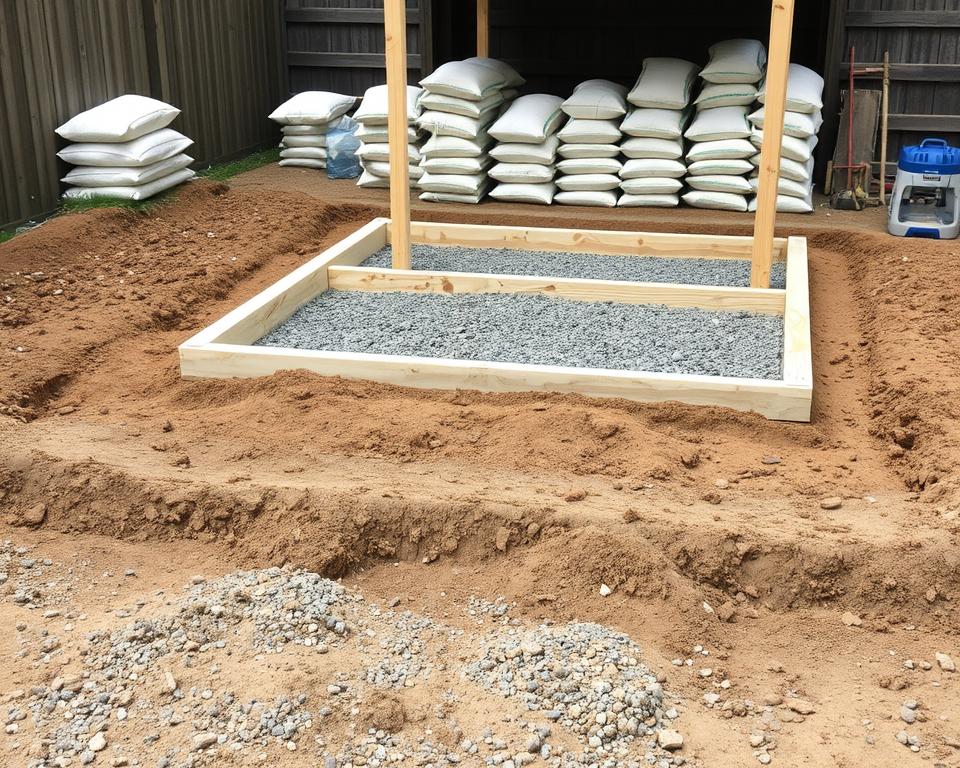
Marking out and setting levels
Use a tape measure, builder’s line and driven timber pegs to mark the four corners. Check squareness with the 3–4–5 triangle method to ensure true right angles. Allow for the finished level by accounting for topsoil removal and the concrete depth you plan to pour.
Transfer levels across the site with a spirit level and straightedge for short runs. For larger areas, a laser level speeds the job and gives repeatable accuracy. Mark a clear finished level on a peg or batten so the team can work to one reference.
Excavation depth and sub-base preparation
Work to the required excavation for concrete base. Typical practice is to remove topsoil to make space for a compacted Type 1 sub-base of 150–200mm plus a concrete slab of 100–150mm and any blinding. For a 150mm slab on a 150mm sub-base you will excavate roughly 300mm.
Place Type 1 in layers of 75–100mm and compact each layer with a plate compactor. Check levels as you go to achieve a uniform, well-compacted surface. On soft or wet soils, fit a geotextile membrane beneath the Type 1 to prevent contamination and improve stability.
Dealing with drainage and ground moisture
Plan drainage solutions early. A slight fall of 1:80–1:100 away from any dwelling promotes runoff and reduces standing water. Where water collects, consider a soakaway or French drain around the perimeter.
Use a damp-proof membrane or a thin blinding sand layer under the slab to control moisture. For high water table or heavy clay soils, consider deeper excavation, improved sub-base design or specialist piled or raised beam options to avoid long-term problems.
| Task | Typical depth | Key action |
|---|---|---|
| Topsoil removal | Variable (usually 50–150mm) | Strip to firm subgrade, dispose or reuse responsibly |
| Sub-base (Type 1) | 150–200mm | Lay in 75–100mm layers, compact with plate compactor |
| Concrete slab | 100–150mm | Design to shed load; include blinding and DPM where needed |
| Drainage provision | As required | Provide fall 1:80–1:100; install soakaway or French drain if needed |
| Soil protection | Geotextile layer | Use under Type 1 on soft or wet ground to prevent contamination |
Formwork and Reinforcement Options
Choosing the right formwork and reinforcement sets the tone for a durable shed base. This short guide covers timber formwork UK practice, basic reinforcement for concrete slab designs and sensible edge and joint details to reduce cracking and movement.
Constructing timber formwork
Use treated timber such as 18–22mm CLS or marine plywood for clean faces. Boards of 100–150mm wide give strong edges when staked with battens. Brace panels well so they stay straight and level under concrete pressure.
Set formwork at the finished height while allowing for surface finish and clearances. Line the inside with polythene to aid striking and prevent suction. Add a 25mm chamfer to exposed edges if you want a neat, rounded profile.
Steel mesh, rebar and alternative reinforcement
For most domestic pads a single layer of welded wire mesh (A142 or A193) placed centrally controls shrinkage cracking. Use chairs or a small concrete haunch to position the mesh at mid‑depth.
If the shed will carry heavier loads, use fabricated bars such as Y10 or Y12 in a grid with correct cover. Maintain cover using plastic or concrete spacers. Consider polypropylene fibres as an alternative to reduce plastic shrinkage and secondary cracking.
Edge details and expansion joints
Provide thickened edges or haunching where point loads occur, for example beneath anchor plates or where the base meets a pathway. This prevents local failure and keeps fixings secure.
Use compressible foam strips or backing rod at perimeters and between bays to allow thermal movement. For small domestic pads, saw‑cut control joints within 24–48 hours to one‑quarter of the slab depth to manage cracking.
Mixing, Pouring and Finishing the Concrete
Getting the mix, pour and finish right makes the difference between a long‑lasting base and a surface that fails early. The guidance below covers practical mixing concrete DIY ratios, ordering ready deliveries, pouring concrete slab tips and the steps to finish concrete shed base correctly.

Mix ratios and ready deliveries
For hand mixing, use a 1 : 2 : 4 ratio by volume of cement : sharp sand : 10mm aggregate. That produces roughly a C20/25 grade suitable for most shed bases. Calculate volume as length × width × thickness and add 5–10% for wastage. For example, a 2.6m × 2.1m × 0.15m slab is about 0.817m3, so order 0.9m3 if using ready‑mix. Many DIYers prefer ready‑mix concrete UK deliveries for consistent strength and easier logistics.
Pouring techniques to avoid voids
Work from one side towards the other and keep a steady supply of concrete to avoid cold joints. Use wheelbarrows for small pours and a pump for larger volumes. A concrete rake helps spread material, while a vibrating poker or tapping with a shovel consolidates the mix and removes trapped air. Tamping underfoot is helpful only for small areas; do not walk on screeded sections.
Screeding and initial compaction
Screed with a straightedge board to strike off to the correct level. Move the board in a sawing motion across timber guides to ensure flatness. Wait for bleed water to come up, then use a wooden float to compact the surface and bring the cement cream to the top. This step readies the slab for final finishing.
Finishing sequence and textures
The accepted sequence is screed → bull‑float or wooden float → edge with an edging tool → steel trowel if a hard, dense finish is needed. For an external shed, give the slab a brushed finish with a stiff broom to create texture and reduce slip risk. Delay steel trowelling until the surface has set slightly; over‑trowelling on a wet day can cause surface blemishes and dusting.
Practical pouring concrete slab tips
Keep tools clean and work in short, manageable runs. Protect newly finished concrete from rain and frost immediately after finishing. Curing begins as soon as finishing completes, so plan protection and wet curing to maintain moisture for the first few days. Using ready‑mix concrete UK simplifies timing and ensures you get the correct consistency for a smooth job.
Curing, Protection and Post-Pour Care
Proper care after pouring determines how well a concrete base performs. Good curing helps the slab reach design strength and limits shrinkage cracks. Weather in the UK affects choices for protection and timing of shed installation.

Curing methods for UK weather conditions
Curing keeps concrete moist so hydration continues. For a C20/25 mix, keep the surface damp for at least seven days. In colder months extend the period because lower temperatures slow strength gain. At higher temperatures guard against rapid moisture loss by shading and frequent wetting.
Use polythene sheeting, wet hessian or a curing compound such as Sika or cement‑based curing agents. Covering for longer gives better durability. Monitor the slab and renew coverings if they dry out or tear.
Protecting the base from frost and rain
Fresh concrete is vulnerable to frost within the first 24 hours. If frost is forecast, cover the pour immediately with polythene or insulated blankets. For light rain a sheet may suffice. For heavy rain build a temporary shelter or tarpaulin frame to prevent surface wash and ponding.
Freezing before the concrete has set can cause loss of surface strength and lasting damage. Take care to protect edges and corners where temperatures penetrate fastest.
When to fit the shed and load-bearing checks
Light use, such as placing a small garden shed, may be acceptable after seven days. For heavier loads or machinery wait until the slab achieves higher strength. Typical curing times concrete slab reach near full design strength at 28 days.
Carry out a few simple checks before installing: confirm flatness and level, look for major cracks, and verify that anchor bolts and base plate positions match the shed manufacturer’s layout. If any defects appear, delay assembly and carry out repairs.
| Action | Timing | Recommended method |
|---|---|---|
| Initial protection | First 24 hours | Polythene sheeting or insulated blankets |
| Moist curing | 7 days (C20/25); longer in cold weather | Wet hessian, periodic spraying, curing compounds (Sika) |
| Rain protection | During pour and first week | Temporary shelter, tarpaulin with frame |
| Frost protection | First 24–72 hours if freezing forecast | Insulated blankets, avoid exposure to low temps |
| Shed installation | Light load: 7–14 days; full load: 28 days | Check levels, flatness, anchors before fitting |
Common Problems and How to Fix Them
Gardens and bases settle over time. Small faults can be fixed without full replacement. Below are clear steps to identify issues like cracking, settlement and poor drainage, with practical remedial fixes suitable for DIY or trades.
Cracking, settlement and uneven surfaces
First, tell hairline shrinkage cracks from structural failure. Hairline cracks often form from rapid drying or slight shrinkage and rarely affect load-bearing capacity.
Wider cracks and dipping slabs point to inadequate sub-base compaction, poor mix or soil movement. To fix cracked concrete that is small, seal with an acrylic sealant. For wider gaps use an epoxy or cementitious crack repair mortar.
If the slab is uneven but only shallowly affected, use a resurfacer or self-levelling compound to restore a level plane. For severe movement, break out the failed section, correct the sub-base and carry out settlement repair shed base by re‑pouring with proper consolidation.
Poor drainage and water pooling solutions
Puddles form when the base lacks fall, drains are blocked or surrounding surfaces are impermeable. Address the cause before patching the surface.
Create a gentle fall away from the shed, add a gravel perimeter or install a French drain. Channel drains or directing gutters and downpipes away from the slab improve drainage for shed base dramatically.
Where water remains persistent, consider permeable paving or increasing the sub-base with well‑compacted, free‑draining material to reduce standing water and pressure on the slab.
Remedial fixes for minor defects
Small defects are often straightforward. Patch spalled edges with a repair mortar and use a concrete bonding agent like SikaBond™ when attaching new material to old concrete.
Seal surfaces with a breathable concrete sealer to reduce water ingress. Re‑screed small low spots with a repair screed. For refitting fixtures, epoxy anchors provide a strong, durable hold.
| Problem | Likely Cause | Practical Fix | When to Call a Pro |
|---|---|---|---|
| Hairline cracks | Shrinkage or rapid drying | Seal with acrylic sealant; monitor | If crack widens or repeats |
| Wide cracks or drop | Poor sub‑base compaction; overload | Epoxy or cementitious repair; re‑pour if needed | Large movement or structural concern |
| Uneven surface | Settlement or poor levelling | Self‑levelling compound or resurfacer | Extensive settlement requiring sub‑base work |
| Water pooling | Insufficient fall; blocked drains | Adjust fall; install French drain; improve drainage for shed base | Persistent flooding despite remedies |
| Spalled edges | Impact, freeze‑thaw or poor finish | Patching with repair mortar and bonding agent; concrete patching UK products available | Extensive spalling around load points |
Cost, Timeframe and When to Hire a Professional
Deciding between a DIY approach and a tradesperson can hinge on budget, time and site complexity. The figures below give realistic UK ballpark costs and a clear project timeline to help you plan. They also highlight practical signs of when to hire concrete contractor expertise.
Estimated DIY costs versus professional quotes
A small shed base (about 2.6m x 2.1m) typically costs £250–£700 if you do the work yourself. This range covers materials, ready‑mix delivery or bulk cement, plus tool hire and basic reinforcement. Choosing mixed‑on‑site concrete, stronger reinforcement or face‑fixed edging lifts the price.
Professional installation for the same pad normally falls between £450 and £1,200 or more. Labour rates, difficult access, drainage work and rock excavation push prices higher. For reliable results, obtain at least three quotes and verify trades through Checkatrade, TrustATrader or your local council listings.
Typical project timeline from start to finish
Preparing and ordering materials takes 1–3 days. Excavation and sub‑base preparation usually need 1–2 days. Building formwork and placing reinforcement is often a single day task. Pouring and finishing the concrete usually takes one day.
Initial curing for light use is around seven days. Full strength develops over 28 days unless rapid‑set products are used to shorten the wait. A typical project timeline concrete base spans one to two weeks, depending on weather and any remedial settling work.
Signs you should call a specialist
Call a professional if access is poor, the shed is large or heavy, or you expect extra loads such as a mezzanine or heavy equipment. Seek help for complex ground conditions like a high water table, expansive clay or contamination. Projects requiring piled or elevated foundations need structural engineering input.
If you lack time, the right tools or confidence to manage a pour and finish, it makes sense to hire concrete contractor services. Always check public liability insurance, ask for written estimates and request references before you commit.
Conclusion
A well-planned concrete base for shed DIY conclusion is that careful preparation pays dividends. A properly designed and executed slab gives stability, extends the life of the building and supports warranty and insurance requirements. Follow the staged approach: planning, site preparation, a correct sub‑base, robust formwork and reinforcement, a controlled pour and finish, and appropriate curing to deliver a durable shed foundation.
Practical best practice shed base UK advice is to use checklists, measure twice and order extra materials to allow for waste. Ready‑mix concrete often improves consistency for small to medium slabs, while safety measures such as PPE and safe manual handling must not be overlooked. Remember UK specifics: check permitted development rules, allow for local weather and frost protection, and source materials from reputable suppliers like Travis Perkins or Hanson when you need technical data or product support.
For DIYers, attempt moderate sized projects if you are confident with tools and mixing; otherwise call a professional. Document the build with photos for warranties and future maintenance. Consult authoritative references such as the Planning Portal and British Standards (BS 8500 for concrete) to ensure compliance and to support a durable shed foundation that will serve for years.
FAQ
What is the primary objective of this guide on a concrete base for shed DIY?
The guide provides a step‑by‑step, professional DIY method for constructing a durable concrete base for a garden shed in the UK. It covers site planning, tools and materials, excavation, formwork, reinforcement, mixing and pouring concrete, finishing, curing, troubleshooting, cost estimates and advice on when to hire a professional. It is tailored to competent DIYers with basic experience and explains specialised tasks such as reinforcement placement and levelling in clear, practical terms.
Who is this guide aimed at?
The target audience is UK homeowners and competent DIYers who want a code‑compliant, long‑lasting shed foundation. The guide assumes familiarity with common tools but explains specialised steps — mixing concrete, setting formwork, placing reinforcement and finishing surfaces — so readers can confidently plan and carry out the work or recognise when to ask for professional help.
How large should the concrete pad be compared with my shed footprint?
As a rule, make the pad at least 50–100mm larger than the shed footprint on every side to allow for fixings and finishing. For example, a 2.5m x 2.0m shed would typically sit on a 2.6m x 2.1m pad. This extra clearance helps ensure doors and frames have room and provides a tidy edge for trims and flashings.
What thickness and concrete strength should I use for a standard garden shed?
For most garden sheds a 100–150mm slab on a compacted Type 1 sub‑base is suitable. Use a C20/25 grade concrete (approximately a 1:2:4 mix by volume if hand‑mixing) for general domestic loads. Increase thickness or use heavier reinforcement if the shed will carry heavy equipment or machinery.
What sub‑base do I need and how deep should I excavate?
Remove topsoil and excavate to accommodate the sub‑base plus slab. A common arrangement is 150mm compacted Type 1 sub‑base plus a 150mm slab, so excavate roughly 300mm. Compact the Type 1 in 75–100mm layers using a plate compactor. Use a geotextile membrane beneath the sub‑base on soft or wet ground to prevent contamination and improve stability.
Do I need reinforcement and what are the options?
Yes—reinforcement controls shrinkage cracking and improves durability. Typical options are a single layer of welded wire mesh (A142 or A193) placed mid‑depth or a grid of steel reinforcement bars for heavier loads. Plastic or concrete spacers (chairs) keep mesh centrally located. Polypropylene fibres or fibre‑reinforced mixes are useful as supplementary crack control.
How should I construct formwork for the slab?
Build rigid timber formwork from treated timber or 18–22mm plywood, well‑braced and staked to resist concrete pressure. Set forms to the correct finished height and check squareness with the 3‑4‑5 method. Line forms with polythene if desired to make removal easier and to protect boards from moisture.
Should I use ready‑mix concrete or mix on site?
Ready‑mix concrete gives consistent strength and saves time for most DIYers; order C20/25 and calculate volume (length x width x thickness), then add 5–10% for wastage. Hand‑mixing (1:2:4) is feasible for very small pads, but expect greater variability. Consider fibre‑reinforced ready mixes or SBR additives for improved crack resistance.
What techniques ensure an even pour and no voids?
Pour from one side and consolidate progressively using a concrete rake or vibrating poker for larger volumes. Screed with a straightedge running on the formwork, then float the surface after bleed water dissipates. Tamping and rodding around edges and bolt plates helps eliminate voids. Proper compaction and correct sub‑base preparation reduce the risk of settlement and voids.
How should I finish the surface for a garden shed base?
For external pads a brushed finish with a stiff broom gives good slip resistance. The finishing sequence is screed, bull‑float or wooden float, edge with an edging tool, then steel trowel if a denser finish is required. Avoid over‑trowelling while the surface is wet, and consider a light chamfer (25mm) on exposed edges.
How long and how should I cure the concrete in UK weather?
Keep the concrete moist for a minimum of seven days for a C20/25 mix; 28 days is the standard for full design strength. Use polythene sheeting, wet hessian or a curing compound (e.g. Sika products). In cold weather extend curing time and protect from frost with insulated covers; in hot, dry weather maintain moisture to prevent rapid drying and shrinkage cracking.
When is it safe to assemble or load the shed on the new base?
Light assembly and partial loading can begin after about 7–14 days, but wait 28 days before subjecting the slab to full design loads where possible. Before starting assembly, check the slab for level, adequate thickness, correct anchor positions and absence of major cracks. Ensure anchor bolts or plate positions were set correctly during the pour.
What drainage and moisture measures should I take?
Provide a slight fall (1:80–1:100) away from buildings to shed water. Install perimeter drainage, channel drains or a French drain where water collects. Use breathable sealers or damp‑proof membranes where necessary and ensure gutters/downpipes direct water away from the pad. For high water‑table or clay soils consider deeper excavation, improved sub‑base or specialist foundations.
How do I prevent and repair cracking or settlement?
Prevent defects by preparing and compacting the sub‑base correctly, using correct mixes, curing properly and providing joints. Hairline shrinkage cracks can be sealed with acrylic sealant. Wider cracks or settlement may require epoxy or cementitious repairs; severe settlement often needs breaking out and re‑pouring after correcting the sub‑base. For small uneven areas use resurfacer or self‑levelling screed.
What are realistic costs for a DIY vs professional installation in the UK?
For a small pad (approx 2.6m x 2.1m) DIY costs including materials and tool hire are typically £250–£700 depending on ready‑mix, reinforcement and hire provision. Professional installation usually ranges from £450–£1,200+ depending on access, site complexity and labour. Prices vary by region; obtain several quotes and check tradespeople via Checkatrade, TrustATrader or local council lists.
How long will the whole project take from start to finish?
Typical timescale: planning and ordering materials 1–3 days; excavation and sub‑base preparation 1–2 days; formwork and reinforcement 1 day; pour and finishing 1 day. Allow at least 7 days for initial curing before light use and 28 days for full strength. Overall, expect the project to span 1–2 weeks including curing.
When should I hire a professional concreter or structural engineer?
Hire a professional if access is difficult, ground conditions are poor (high water table, deep clay, rock), the shed is large or will carry heavy equipment, local regulations require certified installers, or if you lack time and confidence for mixing and pouring. Also consult a structural engineer for piled or specialised foundations. Check contractor insurance, public liability cover and references before appointing.
Which suppliers and products are recommended in the UK?
Common suppliers include Travis Perkins, Jewson, Wickes, B&Q and Selco for materials and tool hire. Ready‑mix suppliers include Hanson and CEMEX. For curing agents and bonding products look to reputable brands such as Sika. Compare prices, delivery charges and ask for product technical data sheets to confirm suitability.
Are there planning or building regulation issues I should check?
Small garden sheds typically fall under permitted development, but height, location near boundaries, use (habitable space) and sites in conservation areas or flood zones can affect permissions. Consult the Planning Portal and your local authority for guidance. Building Regulations rarely apply to simple outbuildings but always verify if you plan to use the shed as a living space or attach services.
What documentation should I keep for warranty or insurance purposes?
Keep records of material invoices, photos of site preparation and the pour, proof of concrete strength or mix specification (from ready‑mix delivery dockets), and details of any contractor work. These support warranty claims with manufacturers such as Jacksons Fencing or Tiger Sheds and help insurance assessments if contents are stored in the outbuilding.
What safety equipment and best practices should DIYers follow?
Use appropriate PPE: gloves, goggles, dust masks, hearing protection and Wellington or steel‑toe boots. Follow safe manual handling practices, avoid working alone during critical operations such as pouring, and be cautious using powered equipment (mixers, plate compactors). Check for underground services before excavation via utility companies or the national service for locating apparatus.