what gazebo has a 100 mph wind rating?
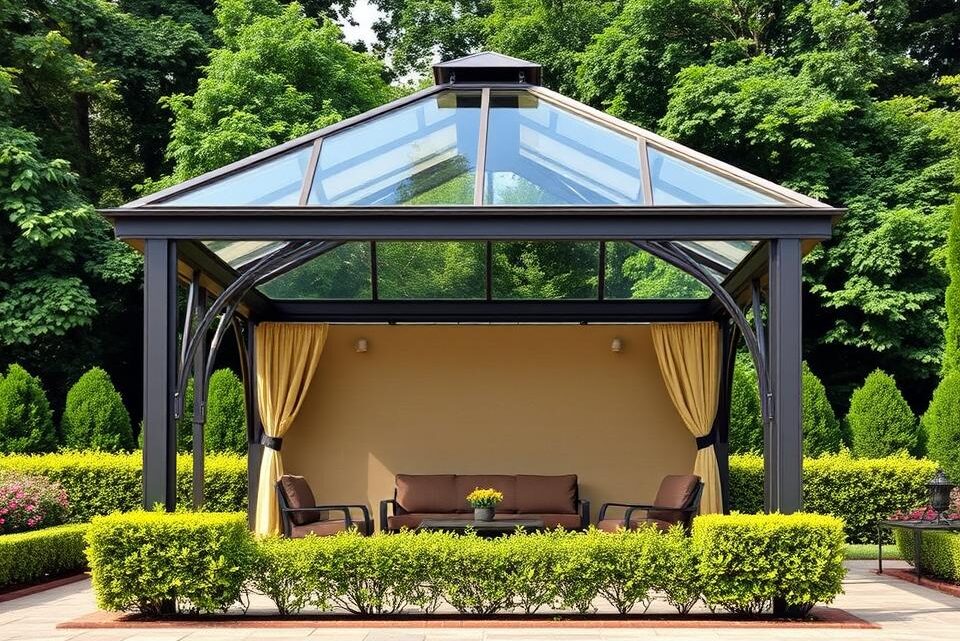
British buyers searching for a 100 mph wind rated gazebo are looking at a rare class of structure. Winds around 100 mph, roughly 160 km/h, mirror violent storm conditions seen in exposed parts of the UK. Very few consumer models are verified for this level, and genuine claims usually apply to permanent or semi‑permanent builds with engineered frames and fixed foundations.
If you need a storm‑proof gazebo UK homeowners can trust in extreme weather, focus on designs built like small buildings, not camping gear. A pop‑up, even when sold as heavy‑duty, is not an extreme wind gazebo. The products most likely to approach this threshold are hard‑top aluminium or steel roof gazebos, louvred roof pergola‑gazebos with lockable blades, and modular commercial‑grade pavilions installed to specification. A high wind pergola UK buyers can rely on will combine rigid materials, triangulated bracing, and professional anchoring.
Scrutinise the evidence. Look for published test data, wind tunnel or field results tied to standards such as EN 1991‑1‑4 for wind actions, plus CE marking under BS EN 1090 for structural steel or aluminium. Check anchoring details, from concrete footings to ground screws. Review warranty terms and seek third‑party verification from accredited labs or engineers before trusting any hurricane‑rated gazebo claim.
The sections that follow explain how wind ratings work, what design features matter most, and which structures can credibly resist near‑hurricane gusts when installed and maintained to spec.
Inhaltsverzeichnis
Key Takeaways
- True 100 mph ratings are rare and usually apply to permanent or semi‑permanent structures.
- Hard‑top aluminium and steel models, and louvred roof pergola‑gazebos, are the strongest candidates.
- Pop‑ups and most soft‑top garden gazebos are not designed for violent storm conditions.
- Demand test evidence linked to EN 1991‑1‑4 and CE marking under BS EN 1090.
- Anchoring is critical: concrete footings or engineered ground screws beat simple weights.
- Seek independent verification and clear warranty terms for any extreme wind gazebo claim.
Understanding wind ratings for gazebos
Gazebo wind claims mean little unless you know how speed is defined and applied. Buyers in Britain face varied exposure, from sheltered gardens to cliff tops. To judge risk from storm force winds Britain, read data against an UK wind speed chart and consider wind loading on structures rather than headline numbers alone.
How wind speeds are measured and reported in the UK
The Met Office reports sustained wind as a 10‑minute average, and also logs Met Office gusts over about three seconds. Coastal and upland sites often post the highest peaks. A “100 mph” reading equates to roughly 87 knots or about 160 km/h and would align with violent storm gusts.
When comparing sites, check the averaging period and location height. A gazebo tested in steady flow may behave differently on a terrace where turbulence and eddies dominate, which raises effective wind loading on structures.
Beaufort scale versus mph and why it matters for buyers
The Beaufort scale UK translates observed effects into standard ranges. Beaufort 12 refers to 64 knots sustained, around 74 mph, with far higher gusts during severe events. Retail labels often cite mph without stating whether it is sustained or a gust figure.
Use an UK wind speed chart to convert knots, mph, and km/h when reading spec sheets. This helps you compare claims against the Beaufort scale UK and typical Met Office gusts for your area.
Static wind rating versus gust resistance in real conditions
Some brands quote a static design pressure using q = 0.613 V² N/m² at sea level. That value, drawn from common engineering practice, relates velocity to pressure but assumes steady flow. Real gust resistance depends on turbulence, wind angle, exposure category, and whether sidewalls are fitted, which can increase uplift.
Local siting per EN 1991‑1‑4—topography, shielding, and fetch—can alter wind actions significantly. Marketing terms such as “windproof” have no fixed meaning unless tied to a recognised protocol, so verify whether figures refer to sustained wind, three‑second peaks, or a static pressure that informs wind loading on structures during storm force winds Britain.
| Measure | Definition | Typical Source | Buyer Implication |
|---|---|---|---|
| Sustained wind | 10‑minute average speed | Met Office site reports | Baseline for exposure mapping and UK wind speed chart comparisons |
| Gust | Peak over ~3 seconds | Met Office gusts data | Drives peak loads and anchoring during storm force winds Britain |
| Beaufort number | Observed effects mapped to knots | Beaufort scale UK | Quick check to relate mph claims to real‑world effects |
| Static design pressure | q = 0.613 V² N/m² at sea level | Engineering calculation or wind tunnel | Indicates wind loading on structures; not a direct gust guarantee |
Key structural features that enable 100 mph wind resistance
High winds exploit weak links. A robust frame, smart joints, dependable fixings, and a stable roof profile work together so loads pass cleanly to the ground. The aim is to cut flex, reduce uplift, and prevent fatigue, especially under sharp gusts common across the UK.
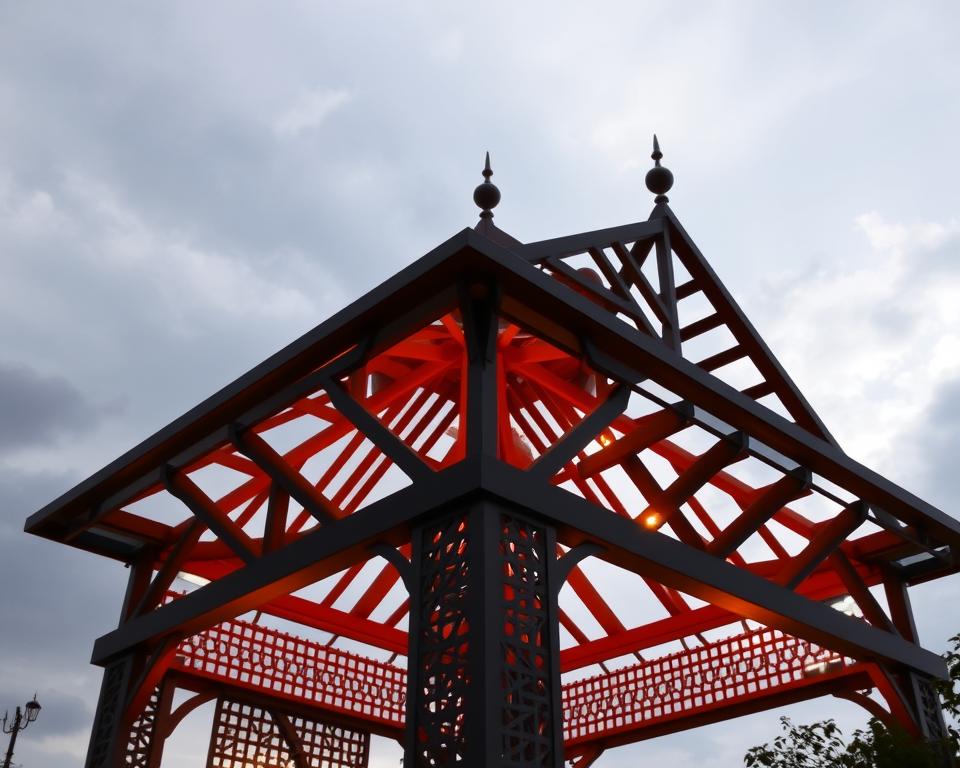
Frame materials: steel, aluminium, and engineered alloys
An aluminium gazebo frame in 6000‑series (such as 6061‑T6 or 6063‑T6) balances strength with low weight and resists corrosion in coastal air. A galvanised steel gazebo adds rigidity and fatigue resistance, with hot‑dip zinc layers guarding against rust. Engineered alloys and CE‑marked members to BS EN 1090 signal controlled fabrication and consistent performance in storms.
Powder coating, UV‑stable finishes, and A2/A4 stainless fasteners help preserve capacity over time. These measures keep joints tight and reduce maintenance, which matters when gusts arrive without warning.
Joint integrity, cross-bracing, and triangulation
Joints decide whether frames rack or stand firm. Full‑depth gussets, welded or bolted connections with graded fasteners, and rigid moment frames resist lateral sway. A cross‑braced gazebo uses diagonals in roof and wall planes to create triangulated bays that hold shape under load.
Knee braces at posts lift moment capacity and tame vibration. This layout channels forces through straight, predictable paths, cutting the chance of progressive failure during peak gusts.
Anchoring systems: ground screws, concrete footings, and weights
Even the best frame needs wind‑resistant anchoring. Cast‑in concrete footings with defined embedment or chemical anchors into sound slabs provide high pull‑out values. Engineered ground screws, such as Krinner‑type systems, deliver reliable performance where excavation is difficult.
Ballast weights can stabilise temporary setups, but they are a supplement rather than a primary fix in 100 mph scenarios. Correctly sized fixings and tested substrates are non‑negotiable.
Canopy fabrics and aerodynamic design to reduce lift
Roof profiles shape pressure. Hard‑top metal panels or interlocking polycarbonate limit the sail effect, while louvred roofs that lock shut and drain via perimeter gutters reduce uplift. A vented apex and pressure‑relief openings form an aerodynamics gazebo canopy that bleeds gusts rather than trapping them.
For soft‑tops, solution‑dyed acrylic or heavy‑denier PVC‑coated polyester with reinforced seams, catenary cuts, and secure keder tracks keeps tension even and curbs flapping fatigue. The result is stable coverage that works with the wind, not against it.
Testing standards and certifications to look for
Before trusting a “100 mph” claim, check how the structure was assessed and by whom. Look for a wind tunnel tested gazebo with data that explains the set-up, the wind profile used, and the limits of the trial. Independent oversight and precise terminology matter when you compare products on paper.

Laboratory wind tunnel testing versus field testing
Laboratory testing is controlled and repeatable. A credible wind tunnel tested gazebo report will state turbulence intensity, boundary layer approach profile, and yaw angles used, so you can gauge cross‑wind and quartering gust effects. That detail helps you compare like for like.
Field testing shows how a unit behaves during real storms on an exposed site. It can prove robustness, but without calibrated instruments and logging of gust duration and direction, results may be anecdotal. The strongest evidence blends both approaches with clear installation notes.
Relevant British, European, and international standards
Structural loading should reference EN 1991‑1‑4 wind actions, with exposure category and terrain defined. For fabrication integrity and marking, look for BS EN 1090 certification covering steel or aluminium components under UKCA or CE routes.
Some louvred roofs cite BS EN 13561 wind resistance classes; useful for mechanisms, but not a direct match for freestanding gazebo frames. Durability claims often add BS EN ISO 9227 salt‑spray data for coatings, while calculations may reference BS EN 1993 or BS EN 1999 for member design, and ISO 12494 where icing is relevant.
Manufacturer documentation and third‑party verification
Ask for a third‑party structural report with stamped calculations by a chartered engineer (MICE or MIStructE). A TÜV tested pergola or SGS inspection adds assurance when paired with a complete technical dossier and an installation manual that states footing sizes, anchor types, and allowable exposure.
Be wary of vague “hurricane‑rated” claims. Trust language tied to velocity, test set‑up, and gust duration, together with EN 1991‑1‑4 wind actions references and BS EN 1090 certification evidence that can be verified.
| Evidence Type | What to Look For | Why It Matters | Typical Source |
|---|---|---|---|
| Wind‑tunnel report | Turbulence intensity, approach profile, yaw angles, failure mode | Provides repeatable limits for a wind tunnel tested gazebo | Accredited lab summary with photos and plots |
| Field test data | Logged peak gusts, duration, direction, site exposure | Proves real‑world behaviour on installed foundations | Instrumented trials during named storm events |
| EN 1991‑1‑4 wind actions | Exposure category, importance factor, serviceability and ULS checks | Aligns loads with Eurocode methodology for the UK | Engineer’s calculations and third‑party structural report |
| BS EN 1090 certification | UKCA/CE marking, FPC audits, weld procedure qualification | Assures fabrication quality for steel and aluminium | Manufacturer’s certificate and notified body audit |
| Durability testing | BS EN ISO 9227 salt‑spray hours and coating system details | Indicates corrosion resistance for coastal or urban sites | Coating supplier datasheet and lab report |
| Mechanism standards | BS EN 13561 class for louvre or blind wind resistance | Supports claims for moving parts, not full frames | Product technical file and test statement |
| Independent inspection | TÜV tested pergola or SGS/BBA inspection with scope defined | Confirms processes and tests beyond self‑declaration | Notified or approved body report |
what gazebo has a 100 mph wind rating?
A genuine gazebo rated 100 mph UK is rare in public specifications. Most off‑the‑shelf models top out lower, even when bolted down. Claims at this level usually refer to engineered, permanently anchored systems designed for a specific site rather than a standard retail box.
Among hard‑tops, Yardistry’s cedar and aluminium frames are robust when fixed to code, yet published figures seldom approach 100 mph. Sojag and Palram‑Canopia list wind resistance for selected models, often around the mid‑range, with snow ratings alongside. These can be a windproof garden structure UK choice for everyday storms, but they are not commonly verified at triple‑digit speeds.
Premium louvred pergola‑gazebo hybrids from Renson — such as Camargue and Algarve — and Brustor — B200 or B250 — publish performance classes under European testing, with values for louvres closed and open. Installed by certified teams on suitable foundations, these are among the highest wind rating gazebo options in the residential market, and are frequently specified for exposed coastal plots.
Commercial modular aluminium frames from Mastertent or Creotecc, and event‑grade systems similar to Pro‑Gazebo and VELAEVENT, can achieve high tolerances when paired with ballast kits, cross‑bracing, and approved anchors. Even so, soft‑top canopies with fabric roofs rarely carry a formal 100 mph label.
For true 100 mph capability, suppliers often deliver custom‑engineered pavilions or pergolas designed to Eurocode wind actions, with engineer‑stamped drawings and defined foundations. Before accepting any headline figure, request formal test data or structural calculations that state if the number refers to sustained wind, gusts, and the exact installation conditions. This due diligence helps you identify storm‑rated pergola brands that match your site and ensures your chosen windproof garden structure UK performs as promised.
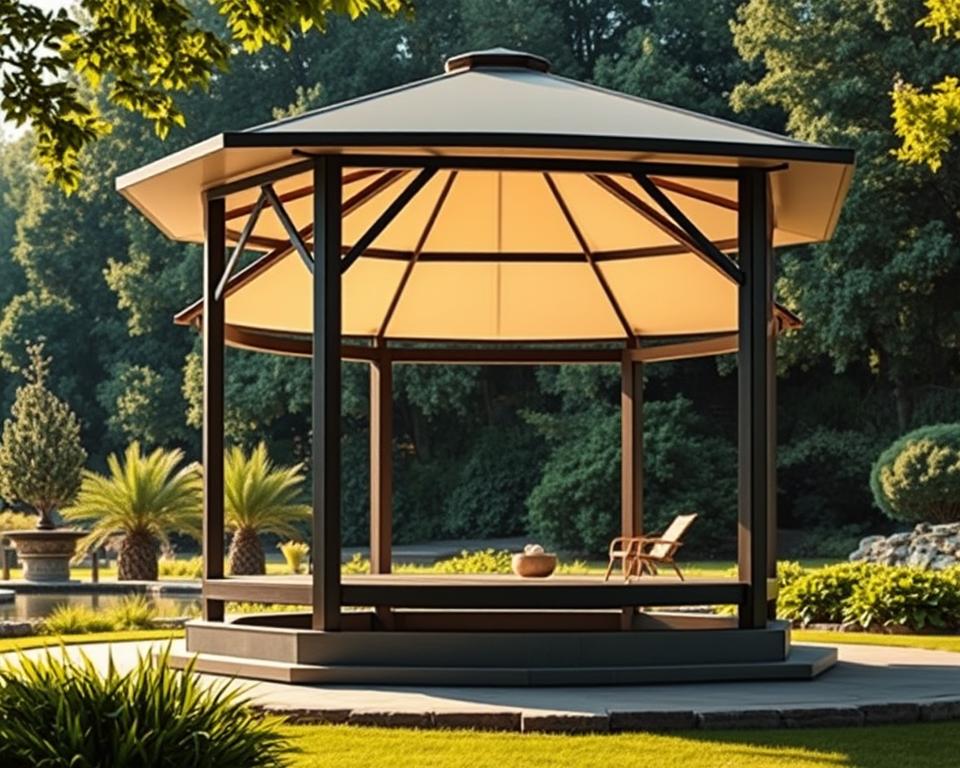
Use the checklist below when comparing a gazebo rated 100 mph UK claim across brands and models.
- Evidence: Wind tunnel reports, Eurocode calculations, and installation notes for fixings and foundations.
- Scope: Clear limits for louvres open/closed, panels fitted, or sides removed.
- Installation: Anchoring method, substrate type, and required spacing for fixings.
- Maintenance: Periodic inspections after storms and torque checks on bolts and brackets.
Permanent and semi‑permanent gazebos suitable for high winds
For exposed British gardens and coastal plots, stability starts with structure. A hard roof gazebo UK buyers can trust blends rigid frames, deep footings, and low‑porosity roofing. Look for published data, clear installation guidance, and hardware that suits concrete pads or ground screws.
When you need an option that stays up in winter, choose brands that state a commercial gazebo wind rating and provide engineering to Eurocode. This raises confidence for a year‑round gazebo Britain can rely on, provided it is anchored as specified.
Note: Wind performance depends on site exposure and fixings; always match the product to the location.
Hard‑top aluminium and steel roof models
Powder‑coated aluminium frames with steel reinforcement deliver stiffness without excess weight. Roofs in galvanised steel or multiwall polycarbonate shed gusts and resist uplift thanks to tight panel locks.
UK‑available examples include Palram‑Canopia Milano and Palermo‑type systems, plus Sojag Messina and Monaco lines. Anchored to concrete, they cite strong snow loads and solid wind resistance, making them a practical hard roof gazebo UK homeowners can specify for exposed patios.
Louvred roof pergola‑gazebo hybrids
Premium louvred designs add control. An aluminium louvred pergola wind response improves with extruded frames, lockable blades, and integrated drainage that prevents panel rattle.
Renson Camargue and Algarve, Brustor B200 series, Weinor Artares, and Solisysteme publish blade‑open and blade‑closed figures. With thicker posts, extra bracing, and correct footings, these hybrids suit coastal plots and deliver a refined, year‑round gazebo Britain can use for dining and shade.
Modular commercial‑grade structures for year‑round use
For frequent events or long dwell time, modular pavilions use bolted nodes, triangulation, and engineered anchors. Look to professional brands such as Mastertent, Gala Tent Pro, and semi‑permanent aluminium pergola suppliers that provide structural calculations.
Deeper posts (around 120–160 mm), thick‑wall extrusions, and certified fixings support a reliable commercial gazebo wind rating. This tier suits courtyards, hospitality terraces, and schools where durability and serviceability matter.
| Category | Representative brands/models | Key structural features | Anchoring approach | Use case in the UK |
|---|---|---|---|---|
| Hard‑top aluminium/steel | Palram‑Canopia Milano/Palermo; Sojag Messina/Monaco | Powder‑coated aluminium frames, steel reinforcement, polycarbonate or galvanised steel roof panels | Concrete pads with mechanical anchors; optional ground screws where soil allows | Residential patios seeking a hard roof gazebo UK buyers can keep up through winter |
| Louvred hybrids | Renson Camargue/Algarve; Brustor B200; Weinor Artares; Solisysteme | Extruded aluminium, lockable blades, integrated drainage, optional side elements and bracing | Reinforced footings with specified bolt cages; coastal upgrades as advised | Premium terraces needing precise aluminium louvred pergola wind control and all‑weather comfort |
| Modular commercial‑grade | Mastertent; Gala Tent Pro; SunSpaces/Aluminium pergola systems with calculations | Bolted nodes, diagonal bracing, 120–160 mm posts, thick‑wall extrusions | Engineered anchors, concrete foundations to Eurocode design | Hospitality and education sites requiring a documented commercial gazebo wind rating for a year‑round gazebo Britain can operate |
Professional installation and anchoring best practice
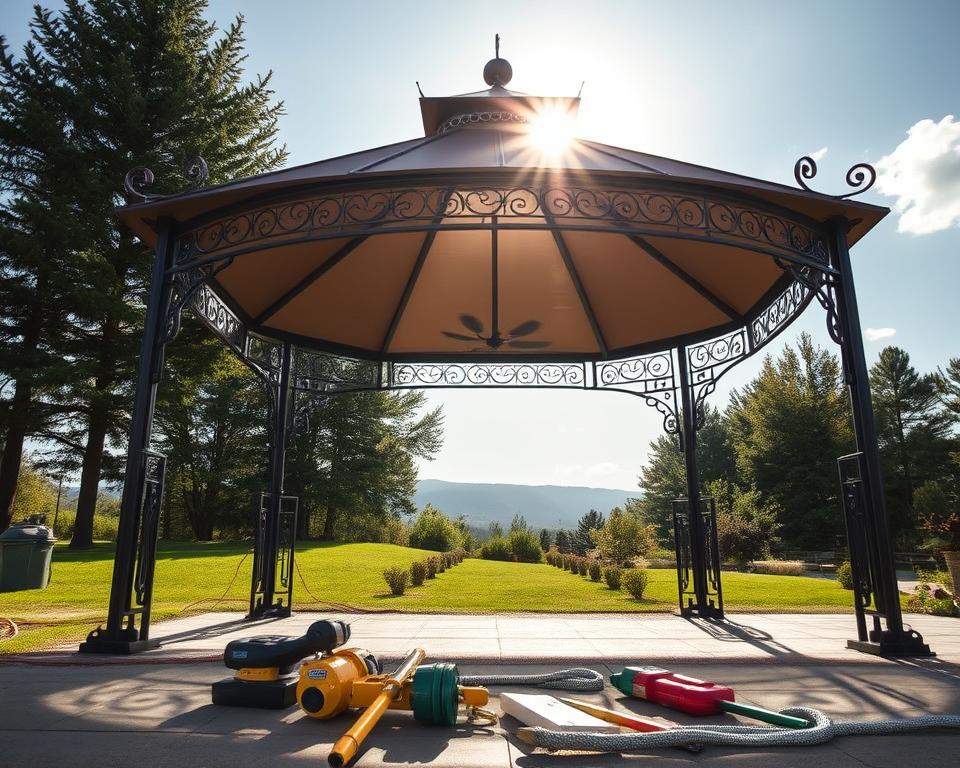
Robust setup starts with context. For gazebo installation UK projects, plan for wind, ground type, and access. Sidewalls and nearby structures change pressures, so the anchoring must match the site rather than a generic spec.
Site assessment: exposure, aspect, and local microclimate
Commission a survey before any fixings are drilled. Map prevailing winds and note funnelling between houses, garages, or hedges. On slopes or cliff tops, topographic speed‑up can be severe under coastal wind exposure UK, so loads rise even on calm forecasts.
Classify exposure as open coastal, suburban, or sheltered, and record aspect relative to the strongest winds. For a ground screws pergola or a hard‑top gazebo, this classification governs anchor type, embedment, and layout.
Foundations and fixings for different ground types
On sound concrete slabs, use ETA‑approved chemical anchors sized to an engineer’s specification. The concrete footings size and edge distances must prevent breakout, with stainless steel studs and isolation pads to curb galvanic corrosion.
On soft or mixed soils, cast reinforced pads or strip foundations with anchor bolts to the required embedment. Where you wish to avoid excavation in gardens, structural ground screws pergola bases can be engineered to torque and pull‑out values, then paired with adjustable post shoes.
Apply anti‑seize to bolts, and separate dissimilar metals with non‑conductive shims. Remember that fitted sidewalls increase wind load; remove detachable panels ahead of storms.
Maintenance checks after storms and seasonal servicing
Adopt a simple gazebo maintenance checklist. After high winds, inspect post bases, brackets, and all connections, then check roof panels, louvre linkages, gaskets, and guttering. Retorque accessible fixings each season and after major gusts.
Clear debris to keep drainage paths open and touch up any powder‑coat chips to prevent corrosion. Log inspections and works for warranty compliance, especially for premium brands such as Palram – Canopia, Yardistry, and Sunjoy used in gazebo installation UK, where records support claims and future servicing.
Materials and canopy choices for British weather
For frames that face salt spray and year‑round rain, choose marine‑grade aluminium with 6063‑T6 thick‑wall extrusions, or a hot‑dip coated galvanised steel gazebo UK build with a high‑build polyester powder coat. In marine zones, match the frame with A4 stainless fasteners and gaskets to stop bimetallic corrosion. Specify finishes verified to BS EN ISO 12944 so the protective layer holds up in harsher corrosion categories.
Rigid roof systems cope well with gusts and heavy showers. Interlocking aluminium sheets resist flex, while steel profiles add mass for stability. Where light is a priority, multiwall polycarbonate roof panels from 6–10 mm or more give impact resistance and safe daylight. Look for UV‑resistant coatings or UV co‑extrusion to prevent yellowing and brittleness under high exposure.
Fabric tops need strength and colourfast fibres. A solution‑dyed acrylic canopy from brands such as Sunbrella keeps colour in bright sun and sheds rain with the right DWR finish. For tougher duty, PVC‑coated polyester in the 650–900 g/m² range offers high tensile strength and low stretch, which helps maintain pitch and shed water during squalls.
Detailing makes the difference in a storm. RF‑welded or double‑stitched seams with UV‑stable thread reduce creep. Reinforced corners, stainless plates, and keder tracks improve load transfer into the frame. Pair these with integrated gutters, downpipes, EPDM seals, and a built‑in fall so runoff exits cleanly instead of pooling at the ridge.
When comparing options, balance airflow and shelter. Solid tops with polycarbonate roof panels and UV‑resistant coatings manage heat and glare, while a vented solution‑dyed acrylic canopy helps bleed pressure in sudden gusts. In coastal or industrial settings, marine‑grade aluminium or a galvanised steel gazebo UK specification will better withstand airborne salts and pollutants over time.
Tip: Match materials to microclimate. Exposed headlands, urban heat islands, and shaded gardens each stress frames and fabrics differently, so select coatings, thicknesses, and fasteners with those patterns in mind.
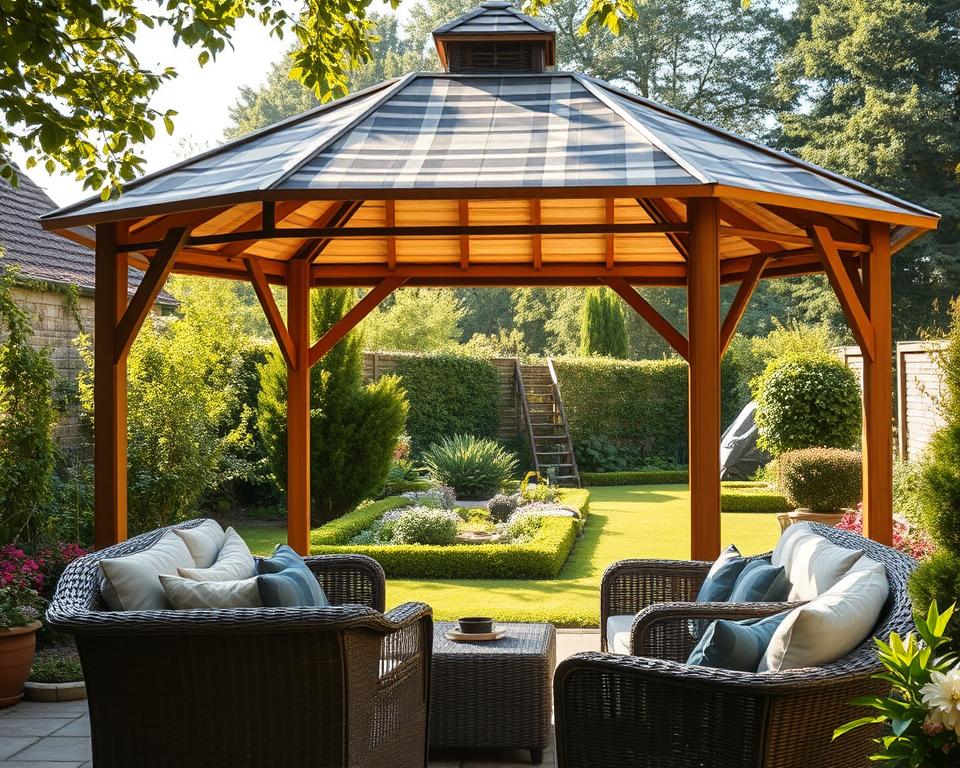
- Frames: marine‑grade aluminium, hot‑dip galvanised steel, BS EN ISO 12944 coatings, A4 stainless fixings.
- Roofs: interlocking metal sheets, multiwall polycarbonate roof panels, UV‑resistant coatings or co‑extrusion.
- Fabrics: solution‑dyed acrylic canopy, PVC‑coated polyester 650–900 g/m², UV‑stable stitching, reinforced corners.
- Weathering: integrated gutters, downpipes, EPDM seals, positive fall to prevent ponding.
Wind management strategies beyond the gazebo
Strong setups start with the wider site, not just the frame. Pair a robust structure with smart landscape choices and careful gazebo orientation wind to cut loads and improve comfort in changeable British weather.
Using windbreaks, fencing, and landscaping for shelter
A well planned garden windbreak UK reduces speed without causing back‑eddies. Choose permeable barriers—slatted fencing, hornbeam or yew hedging—with 30–50% gaps. With good shelterbelt design, protection extends several times the height of the barrier.
Stagger windbreaks to diffuse gusts before they reach seating zones. Keep distance equal to two to five times the windbreak height for a smooth flow path. Avoid solid walls upwind of the canopy, as they can force wind under the roof and lift it.
Orientation and placement to minimise uplift
Place the gazebo on the leeward side of a garage, mature trees, or a hedge, ensuring safe clearances. Align the narrowest face to the prevailing wind, and keep eaves tucked from the dominant flow to reduce edge suction.
Mind drainage and access lines so water and foot traffic do not clash with your layout. Thoughtful gazebo orientation wind choices help keep loads predictable when the weather turns.
Detachable sidewalls and vented apex designs
Removable side panels are useful for showers and privacy, but they raise internal pressure in squalls. Use quick‑release fixings and take panels off when storms are forecast. Leave corners partially open in breezy spells to relieve pressure peaks.
A vented roof gazebo or louvred model provides pressure relief. Open the vent or tilt blades to bleed gusts in moderate winds, following maker guidance for severe conditions. Combined with good shelterbelt design and a tuned garden windbreak UK, these features lower uplift without losing comfort.
Safety considerations and legal responsibilities
Before you order a storm‑ready shelter, check UK planning permission gazebo rules for your address. Permitted development often applies, but heights, proximity to boundaries, conservation areas, and listed buildings can change the outcome. When in doubt, speak to your local planning officer and keep written advice.
Many light structures fall outside building regulations outbuildings guidance, yet fixed canopies, heavy frames, and any unit attached to a dwelling may be notifiable. Your insurer may ask for proof of competent installation and engineering details. Keep invoices, photos, and specification sheets for any claim.
Product safety is not optional. Look for CE/UKCA compliance on labels and in manuals, and expect traceable steelwork under BS EN 1090 where structural components are supplied. Retain the declaration of performance, wind test reports, and the maker’s maintenance schedule.
The homeowner duty of care applies once the gazebo is in use. Anchor to suitable foundations, cap sharp edges, and route cables with RCD protection. After high winds, inspect fixings, joints, and canopies, and remove hanging heaters or sidewalls when Met Office warnings escalate.
Event operators must go further. Follow the Institution of Structural Engineers guidance on temporary demountable structures, produce risk assessments and method statements, and set clearly defined wind triggers for evacuation and takedown. Train staff and brief contractors before build and before opening.
- Planning and siting: Confirm UK planning permission gazebo status; record boundary distances; check trees, utilities, and access for emergency services.
- Regulatory scope: Review building regulations outbuildings exemptions; if bolted to the home or exceeding thresholds, seek professional advice from a chartered engineer.
- Compliance and quality: Verify CE/UKCA compliance, BS EN 1090 for relevant frames, and keep certificates and manuals for audits and insurance.
- Operations: Define a homeowner duty of care checklist: torque checks, water run‑off control, snow‑load removal, and lockout of heaters during gusts.
- Accountability: Understand product liability UK expectations; store serial numbers, supplier details, and service logs to support traceability.
| Aspect | What to confirm | Evidence to keep | Who is responsible |
|---|---|---|---|
| Planning status | Permitted or consent needed under UK planning permission gazebo rules | Email from council, site sketches, measurements | Homeowner or venue operator |
| Regulatory coverage | Whether building regulations outbuildings apply or structural sign‑off is required | Engineer letter, calculations, installation photos | Homeowner; installer if contracted |
| Product conformity | CE/UKCA compliance and BS EN 1090 where structural components are supplied | Markings, declaration of performance, test reports | Manufacturer; purchaser to verify |
| Insurance conditions | Proof of competent installation and maintenance regime | Invoices, service records, risk checks | Policyholder |
| Operational safety | Homeowner duty of care and event wind thresholds with takedown plan | RAMS, inspection logs, training records | Homeowner or event manager |
| Liability and recall | Traceability for product liability UK and defect action | Serial numbers, supplier contacts, batch data | Manufacturer and owner |
Buying tips for UK homeowners and event professionals
Choose a wind‑rated gazebo the way you’d choose a roof: by the numbers, not the paint. Read spec sheets with care, check how the structure will be installed on your site, and weigh ongoing duties as part of the decision. Treat the gazebo warranty UK as a performance contract, not a promise in a brochure.
Interpreting spec sheets and warranty terms
Confirm whether the quoted wind figure is sustained speed or gusts, and what test method was used. Look for any wind class or standard referenced, such as EN 1991‑1‑4 for wind actions. Note the installation conditions required to achieve that rating, including anchoring to concrete, ballast, and whether sidewalls must be removed in high winds.
Scrutinise post sizes, wall thickness, the aluminium or steel grade, and fastening class. Verify the foundation requirements and corrosion protection, such as hot‑dip galvanising or marine‑grade powder coat. Read the gazebo warranty UK for wind exclusions, storm thresholds, and maintenance obligations; some premium brands warrant performance only when installed by approved partners with documented service records.
Questions to ask retailers and installers
Request structural calculations gazebo to EN 1991‑1‑4 for your postcode exposure. Ask for anchor and footing details suitable for your ground type, plus coating and fixings specifications. Seek independent test reports, for example from TÜV or SGS, and confirm spare parts availability, lead times, and aftercare.
Use an installer checklist to compare quotes: site survey, foundation design, anchor type, torque settings, sealants, and commissioning sign‑off. Enquire about service intervals after storms, and whether emergency call‑outs are available. If you plan staged payments or upgrades, discuss pergola financing UK and how certified installation affects eligibility.
Total cost of ownership versus upfront price
Budget beyond the box. Include foundations, professional installation, scheduled maintenance, and any insurance excess for storm damage. Account for optional storm braces, upgraded fixings, and replacement canopies over time.
When you model lifecycle costs shelter, a higher‑priced, engineered pergola with certified installation can outlast several soft‑top replacements. Consider energy and time costs too: fewer call‑outs, faster part swaps, and secure anchors reduce downtime for venues and event schedules.
Conclusion
Reaching a “100 mph wind rating” is a high bar, yet UK buyers can approach it with the right design, build, and fixings. The best 100 mph gazebo will be a permanent system with a rigid frame, certified foundations, and hardware installed to Eurocode guidance. In practice, a premium louvred aluminium model or a hard‑top steel or aluminium gazebo, specified and anchored by an engineer‑rated gazebo specialist, offers near‑hurricane resilience for exposed plots.
Claims must be more than marketing. Look for structural calculations, references to BS EN standards, and installer sign‑off. A credible high wind gazebo recommendation balances frame strength, cross‑bracing, and proper anchoring with ground screws or reinforced concrete pads. Placement still matters: use shelter from walls, hedging, or fencing, and orient the roof to manage gusts. Seasonal checks after storms keep fixings tight and drainage clear.
Start with a site assessment that factors aspect, elevation, and coastal exposure. Choose robust alloys, corrosion‑resistant fasteners, and vented or louvred roofs to cut uplift. For many homes, a storm‑proof pergola UK solution—installed by a reputable contractor who can adapt specifications to local wind maps—delivers the safest result. Work with recognised brands and installers who provide documentation, warranty clarity, and proof of test data to ensure the best 100 mph gazebo standard is met in real conditions.
In short, the path to a durable, engineer‑rated gazebo is clear: assess the site, specify strong frames and anchors, position for shelter, and maintain it on a schedule. Do this, and a storm‑proof pergola UK or hard‑top gazebo can stand calm when the forecast turns rough, meeting the spirit of a high wind gazebo recommendation for the British climate.
FAQ
What gazebo has a 100 mph wind rating?
Very few consumer gazebos are genuinely rated to 100 mph. Claims at this level usually relate to engineered, permanent or semi‑permanent structures with fixed foundations and verified testing. Look to premium louvred aluminium pergolas and hard‑top aluminium or steel roof models installed to EN 1991‑1‑4 with documented anchoring. Pop‑up and most soft‑top garden gazebos are not designed for such extremes, even when labelled heavy‑duty.
How are wind speeds measured in the UK, and what does 100 mph mean?
The Met Office reports sustained wind (10‑minute average) and gusts (3‑second peaks). 100 mph is roughly 87 knots or 160 km/h and aligns with violent storm gusts. Beaufort 12 indicates hurricane force at 64 knots sustained (about 74 mph), with higher gusts. Always check whether a product’s figure refers to sustained wind, gusts, or a calculated design pressure.
What is the difference between a static wind rating and real‑world gust resistance?
Static ratings come from engineering calculations or wind‑tunnel data under steady flow, often using q = 0.613 V² N/m² at sea level. Real‑world gust resistance depends on turbulence, direction, exposure category, and sidewalls that raise internal pressure and uplift. Local siting per EN 1991‑1‑4—topography, shielding, and fetch—can change wind actions significantly.
Which structural features help a gazebo withstand 100 mph winds?
Strength starts with materials: powder‑coated aluminium such as 6061‑T6 or 6063‑T6, galvanised or stainless steel, and CE/UKCA‑marked structural members to BS EN 1090. Robust joints with gussets, grade‑rated bolts, welded or bolted moment frames, and triangulated cross‑bracing increase stiffness. Proper anchoring—concrete footings, chemical anchors, or engineered ground screws—defines real performance. Aerodynamic hard‑tops, lockable louvres, and vented designs reduce uplift.
What anchoring systems are appropriate for high‑wind installations?
For slabs, use ETA‑approved chemical anchors sized by a chartered engineer. On soft ground, cast‑in reinforced concrete pads or strip footings with specified embedment are typical. Structural ground screws (Krinner‑type) can work when designed to torque and pull‑out values for the soil class. Ballast weights help temporary setups but are rarely adequate near 100 mph.
Which brands and models should UK buyers research for high wind resistance?
For hard‑tops, review Palram‑Canopia and Sojag ranges, and Yardistry for timber‑aluminium hybrids; public specs often cite moderate to high winds and snow loads, but 100 mph is uncommon. For louvred pergolas, premium systems from Renson (Camargue, Algarve), Brustor (B200/B250), Weinor Artares, and Solisysteme publish wind data with blades open/closed and are frequently specified for coastal sites. Commercial‑grade options include Mastertent and Gala Tent Pro for modular structures; confirm anchoring kits and bracing. Seek engineer‑stamped calculations for site‑specific wind actions.
What testing standards and certifications should I look for?
Key references include EN 1991‑1‑4 for wind actions, BS EN 1090 for conformity of structural steel and aluminium (CE/UKCA), BS EN ISO 9227 for corrosion testing, and BS EN 13561 for wind resistance classes relevant to some louvred roofs. Credible claims may be supported by TÜV, SGS, or BBA reports and structural calculations signed by MICE or MIStructE professionals. Be wary of vague “hurricane‑rated” language without defined test setup and gust duration.
Are pop‑up or soft‑top gazebos ever suitable for 100 mph winds?
No. Even reinforced event‑grade soft‑tops with ballast and guying are not intended for such extremes. Some commercial frames tolerate higher winds with full anchoring and bracing, but 100 mph claims for fabric canopies are rare and should not be relied on without formal documentation and controlled testing.
How should I interpret a manufacturer’s wind rating?
Confirm whether the figure refers to sustained speed or 3‑second gusts, and the installation conditions—anchored to concrete, exposure category, sidewalls fitted or removed. Check any standards cited, post size, wall thickness, alloy grade, fastening class, and required footings. Review warranty wind exclusions and maintenance obligations.
What materials and roof options cope best with British weather?
Choose marine‑grade aluminium (6063‑T6 thick‑wall extrusions) or hot‑dip galvanised steel with high‑build powder coat. Use A4 stainless fasteners in coastal zones. Roofs with interlocking aluminium or steel sheets, or multiwall polycarbonate with UV co‑extrusion, add rigidity. For fabrics, solution‑dyed acrylics like Sunbrella or PVC‑coated polyester (650–900 g/m²) with RF‑welded seams perform well. Integrate gutters, downpipes, EPDM seals, and ensure coatings meet BS EN ISO 12944 where relevant.
How do site placement and landscaping affect wind loads?
Permeable windbreaks—slatted fences or hedges with 30–50% porosity—reduce wind speed without dangerous turbulence. Place the structure leeward of buildings or natural features and orient the narrow face into prevailing winds. Keep roof overhangs away from wind funnels and maintain drainage paths.
Should I use sidewalls in high winds?
Sidewalls increase internal pressure and uplift. Use quick‑release systems and remove panels ahead of storms. Vented apex designs and pressure‑relief openings help equalise pressure. For louvred roofs, follow manufacturer guidance: lock blades or open them as specified for extreme events.
What installation practices improve safety and performance?
Commission a site assessment for exposure and microclimate. Build foundations to specification with correct embedment and isolation pads to prevent galvanic corrosion. Use stainless fixings and anti‑seize. After storms, inspect connections, roof panels, louvre linkages, seals, gutters, and anchors. Retorque bolts seasonally and document maintenance for warranty compliance.
Do I need planning permission or Building Regulations approval?
Many freestanding gazebos fall within permitted development, but conservation areas, listed buildings, boundary distances, and height limits can alter requirements. Substantial, fixed, or attached structures may trigger Building Regulations, especially for structural safety. Insurers may request proof of professional installation and conformity with CE/UKCA marking where applicable.
What evidence should I request before trusting a “100 mph” claim?
Ask for structural calculations to EN 1991‑1‑4 for your postcode exposure, foundation drawings, anchor specifications, and third‑party test or inspection reports from bodies such as TÜV, SGS, or BBA. Seek clear statements defining sustained versus gust speeds, test setup, and allowable exposure categories.
What does total cost of ownership look like for a wind‑resistant gazebo?
Factor in foundations, professional installation, corrosion protection, periodic servicing, storm damage excess, and optional braces. Over ten years, a certified louvred pergola or hard‑top with proper anchoring can cost less than repeatedly replacing consumer soft‑tops after severe weather.
Are wind‑tunnel results better than field performance data?
Both matter. Wind‑tunnel tests provide repeatable results with controlled turbulence and yaw angles. Field data show robustness in real storms but can be anecdotal without instrumentation. The strongest case combines laboratory testing, Eurocode‑based calculations, and documented site‑specific installation.